
One of the coolest fucking things about Guadalupe Mountains National Park is just how diverse its landscape is and the Salt Basin Dunes drive this home. In fact, these gypsum salt dunes may just be the most unique biosphere within the park.
Table of Contents
Recommended Supplies
- Water
- Spare tire (not flat)
- Sunhat
- Sunscreen
- Navigation app
What is a Salt Basin?
To the West of the Guadalupe Mountains, at a humble 3,630 feet of elevation, is a salt basin / salt flat. Salt flats are areas of land dominated by salt and other minerals that give them a bright white appearance. They form naturally when waters from an ocean (or other water source) evaporate – and remember, this whole area used to be underwater – leaving behind minerals from dissolved salt ions.
These gypsum grains (white minerals) form bright white sand dunes and cover 2,000 acres on the Western end of GUMO. These dunes range from short, stumpy, and vegetated 3 footers to stunningly tall, naked 60 foot high sand dunes at the north end.
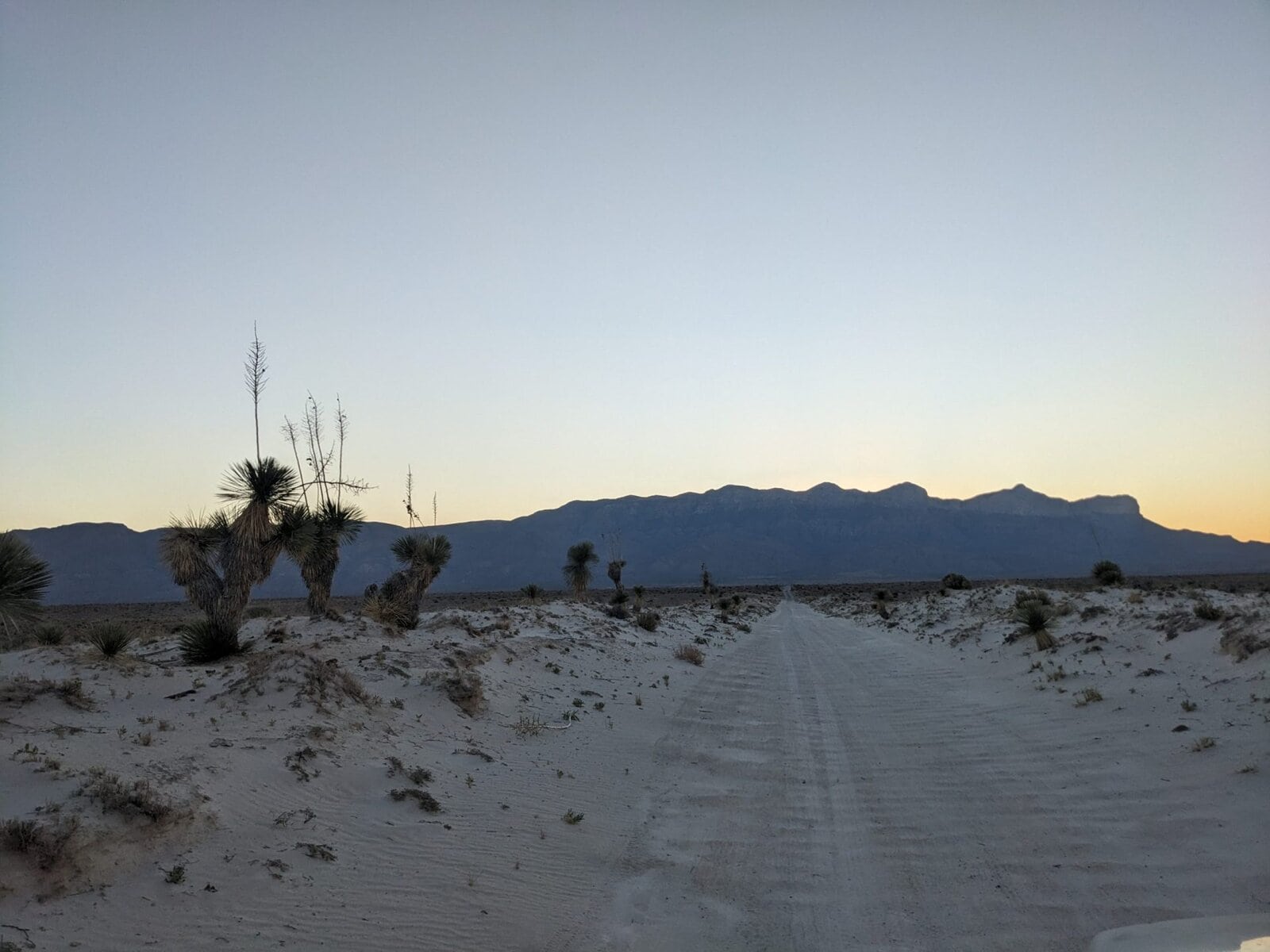
View driving to the Sand Dunes trailhead
That may not compete with the sand dunes you see in movies (or the Sahara), but it’s hella big in person, and a shocking sight to find here in Texas.
How to Find the Salt Basin Dunes
Getting there requires a drive that many park visitors seem unwilling to make. The Ranger described the area as “pretty quiet” to me, and that checked out during my exploration.
From Pine Springs Visitor Center, turn right on Highway 62/180 and go West. At Salt Flat, turn right on FM road 1576 and continue for 17 miles. At this point, you’ll turn right onto William’s Road, which is 7.5 miles of hard clay.
Regarding Williams Road
It’s clay.
Clay becomes very slippery when wet. Yes, that means the road is impassable after rain. Please do not fucking die trying to see these dunes on a rainy day.
Always check with a ranger about road conditions prior to setting out.
Accessing the Salt Basin Dunes
The first 6 miles on Williams Road are easy and not particularly bumpy. Your grandma could take it in a Prius. Views of the Guadalupe Mountains are breathtaking as you drive in, especially at sunrise when I visited.
You’ll encounter an eclectic mix of dilapidated RVs, garbage, old cars, and ranch buildings running along the road. Perhaps the most interesting of these is CL Ranch House. The sign on the fence reads “No guns. Please no trespassing.”
Terribly polite for your average West Texas rancher, who generally convey more of a “get the hell off my property” shotgun-toting vibe with their signage. Learn more about trespassing law in Texas here
The last two miles on Williams Road are graded and have a few small potholes but are accessible to any vehicle with careful driving, in my opinion. 5 ply tires definitely wouldn’t hurt, though.
It would be terribly easy to blow a tire out there. I had no cell service.
The Salt Basin Dunes Trailhead
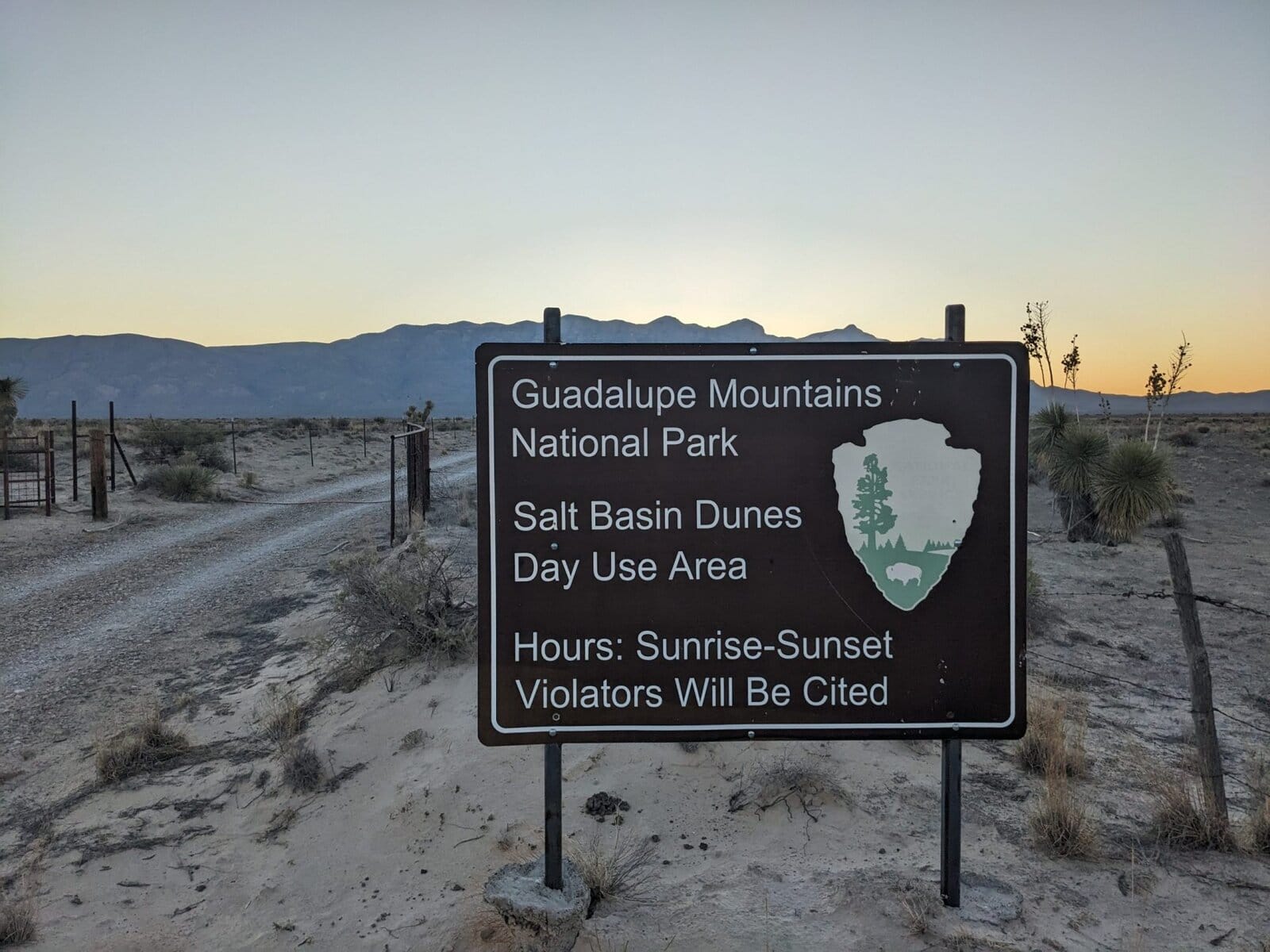
The Salt Basin is explicitly day use only. Absolutely no camping. The hours are “sunrise to 30 minutes after sunset”. I arrived shortly after sunrise and felt very good about that choice.
At the trailhead there is plenty of parking (I was the only one out there), a pit toilet (very clean and well stocked, mind you) and a shaded picnic table.
There is no water at the trailhead.
Bring everything you need. See my recommended supplies above for the bare minimums I took with me, but please use your own discretion.
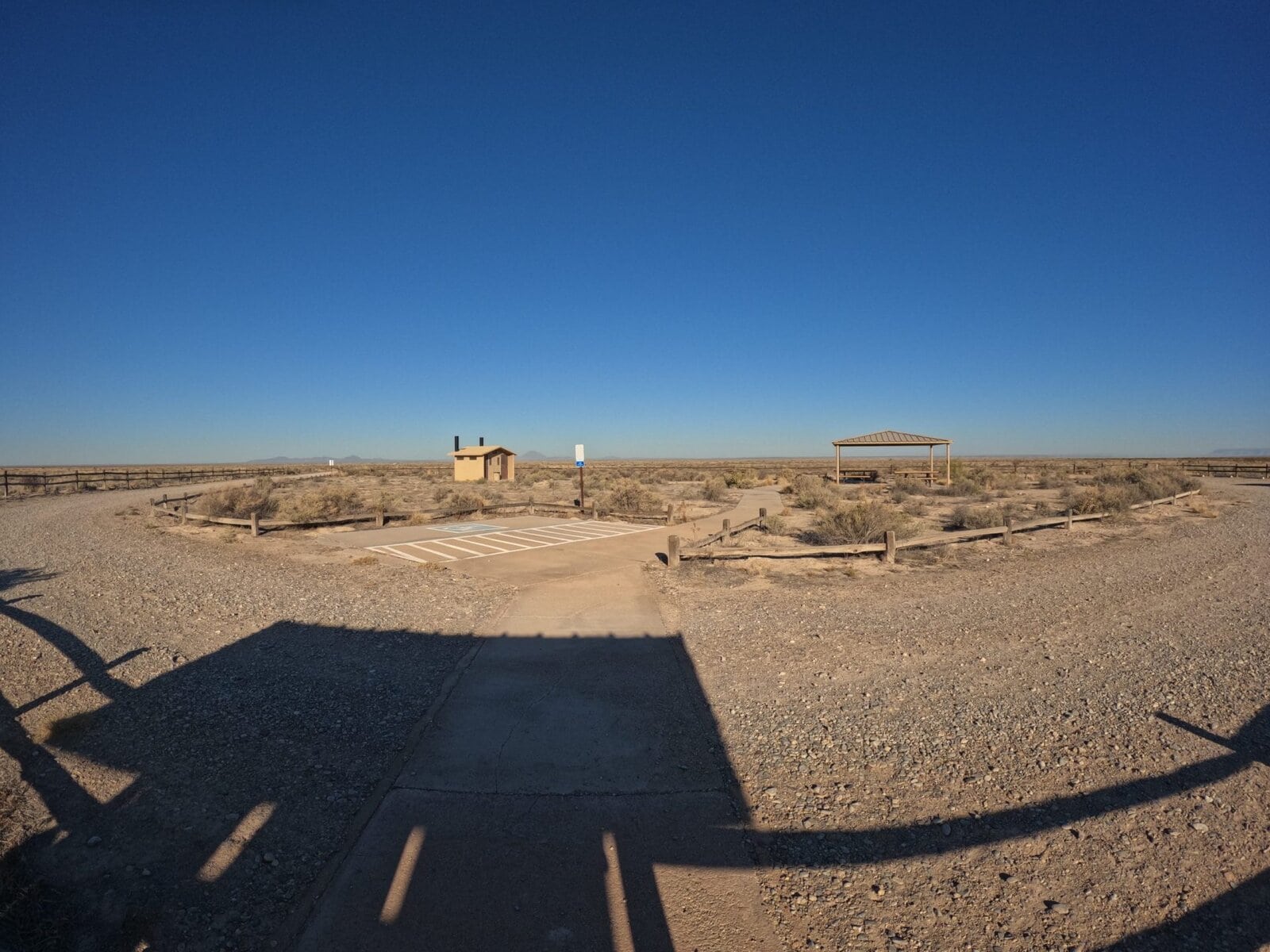
Heat and Wind can make the Salt Basin Dunes “inhospitable”
This area is very hot and not the best place to explore in summer. When you do go, I’d recommend morning to get the coolest temps.
Keep in mind that high winds during winter and spring may make the area “inhospitable”, in the words of the NPS. I’d imagine that means strong and frequent gusts whipping sand grains into every crevice imaginable.
Ever been whipped by sand crystals? I have.
Would not recommend.
Don’t Forget Your Water!
Carry more water than you think is necessary and remember that there is no water at the trailhead – bring in everything you need. For this area, 1 quart per person per hour is recommended.
Hiking The Salt Basin Dunes
The hike to the dunes is 1.5 miles one way. For the first mile, the ground is hard packed clay and easy to fly along at the brisk pace of 18 minutes per mile, carrying water, snacks and an abundance of joy.
I wondered where the hell these alleged sand dunes were as I trotted along, because for the first mile I couldn’t see them.
After that first mile, however, the trail morphs into sand underfoot, which is never fast going and I began to catch glimpses of the dunes. My heart soared in excitement.
Leave No Trace, Stay on the Trail
It’s actually incredibly important to the environment here that you stay on the trail.
To the sides of the trail there is cryptogamic crust, also known as biologic soil crust. This stuff is extremely fragile and can be damaged by a single footprint. Not to get too geeky here but Cryptogams, which are a lichen and fungal association, are actually really important. They produce nitrogen and prevent wind erosion.
One footstep can easily destroy the cryptogamic crust, and a thin layer takes 5-7 years to grow back. A crust that was several centimeters deep, however, can take more than 100 years to recover.
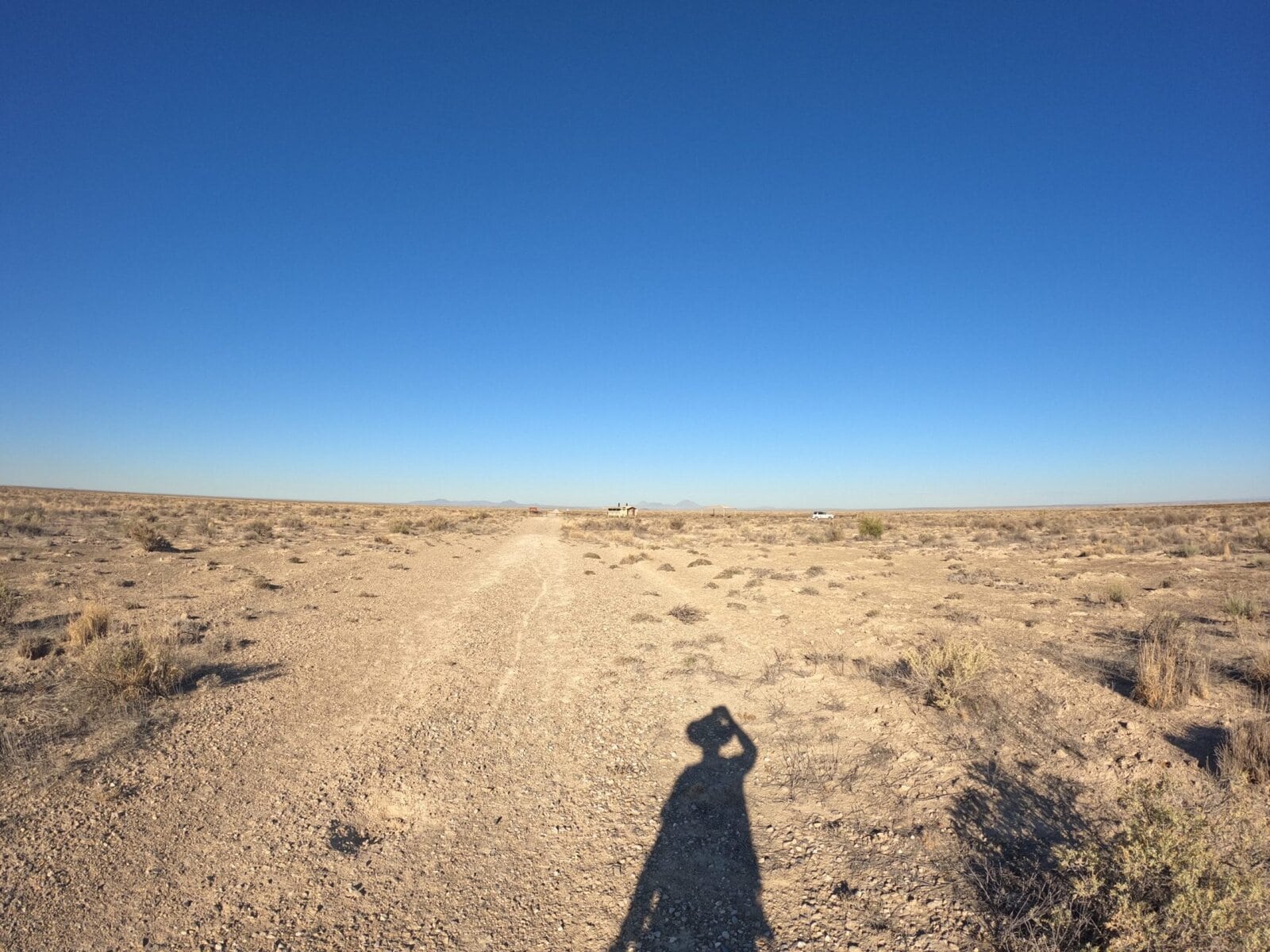
Your footsteps have long-lasting impacts out here. Be sure they are not footprints of death and destruction and stay on the fucking trail, thank you very much.
Hopefully I’ve convinced you to be mindful of where you place your clodhoppers after all that and you want to be on the lookout for this wondrous crust. Easy peasy. The cryptographic crust looks like a hard layer of sand over the softer sand underneath and is easy to identify, even to an ignoramus like yours truly.
Wildlife in the Salt Basin Dunes
Apart from watching out for the cryptographic crust, keep your eyes peeled for snakes, lizards, scorpions, and birds. You should be aware that venomous snakes have been reported in this area.
If you see a snake, remember to give it plenty of space and go around. Do not hurt the snake. If you leave it alone, it will leave you alone.
I saw plenty of lizards in the Salt Basin, which apparently are a white variant of the lesser earless spiny lizard. Thankfully, I was unaware that 5 of the park’s scorpion species can be found here and did not run across any. I fucking hate arachnids.
I also saw small birds running across the dunes and plenty of bird tracks on the smooth blown sand.
End of the Trail
At the end of the 1.5 mile trail, I ran into a sign that pointed back in the direction of the parking lot. There are no designated trails in the sand dunes so it is very easy to get disoriented. You do not want to head off in the wrong direction when you’re ready to go back to your car.
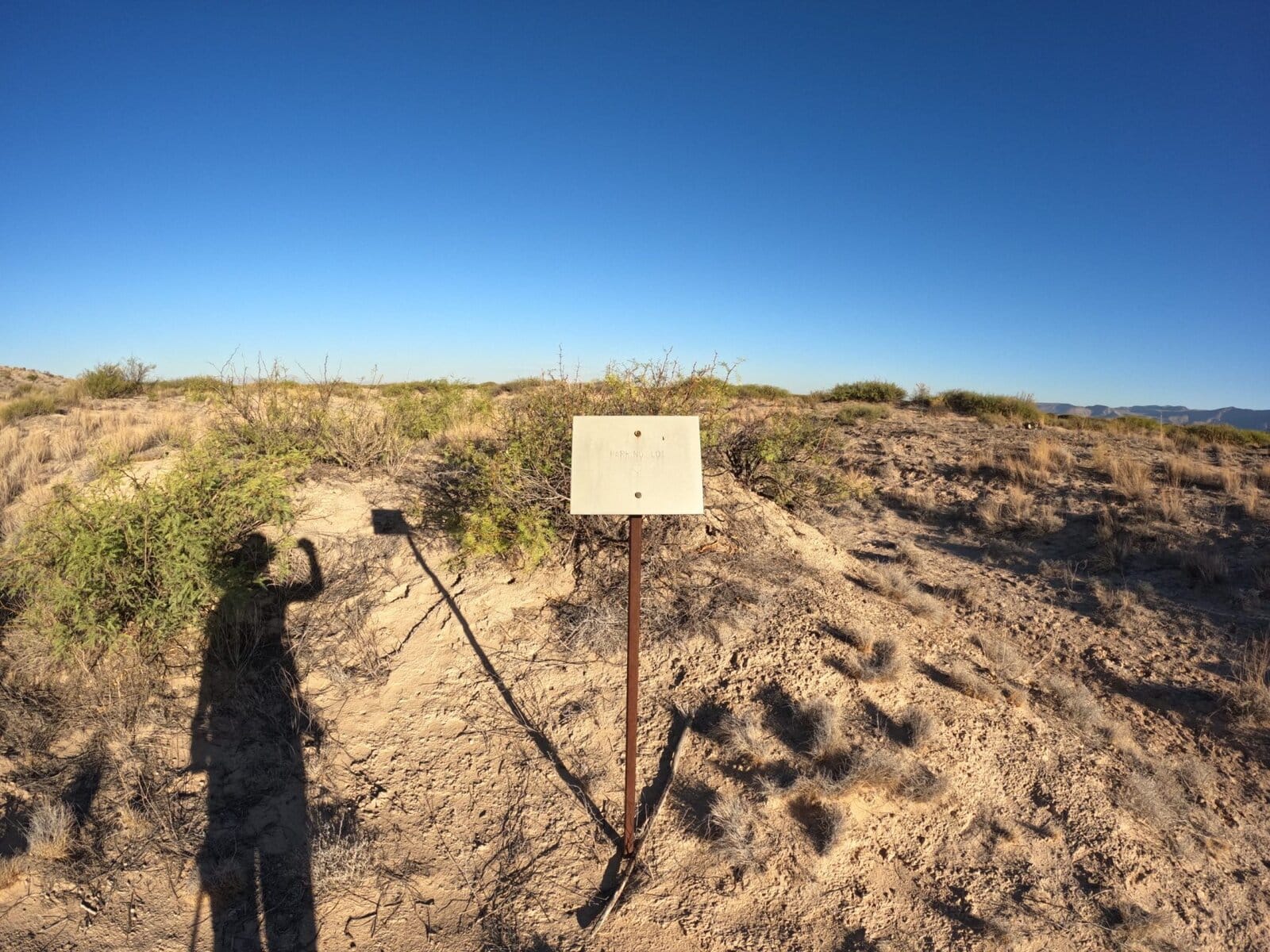
Make sure you always know where the trail is, and stay alert!
There are a few fence posts across from this sign. Go through those posts and the dunes are right there. These initial dunes are small and vegetated. I saw lots of human tracks in this area.
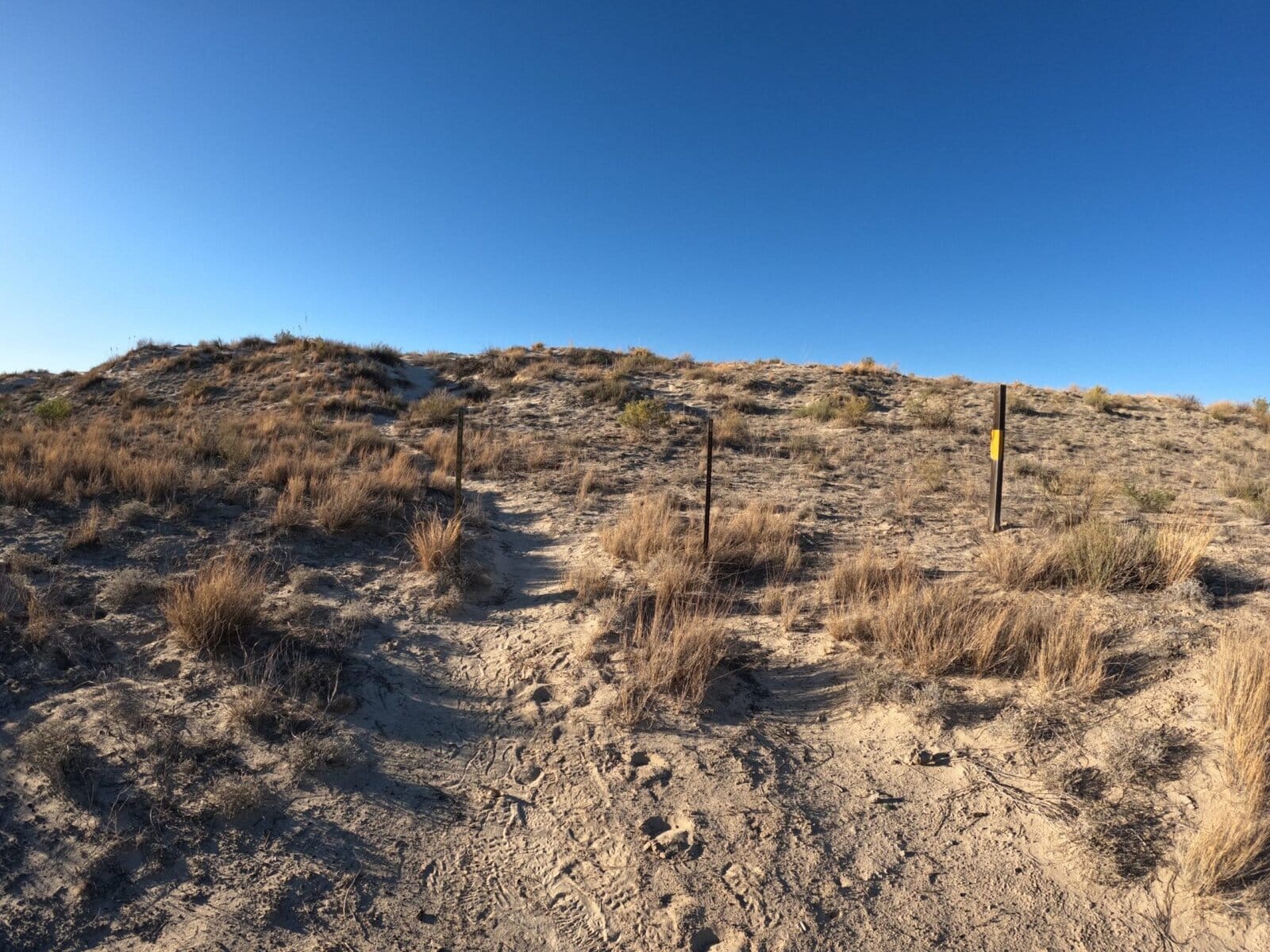
Go through these fence posts and wonder awaits!
Fortunately, the cryptographic crust does not grow in this excessively soft sand. You should be able to explore without destroying hundreds of years of ecologically sensitive bacterial growth.
That sentence felt weird, but I’m standing by it.
Exploring the Sand Basin Dunes
Once you’re in the dunes and off the trail you are free to explore at will. I wandered parallel to the mountains, a little nervous about being able to find my way back. There were so many other people’s tracks that I wasn’t sure if I’d be able to follow my own back to the trail. Because the sand is so loose my footprints weren’t true tracks, just blobs in the sand.
I turned on GaiaGPS just to be safe.
As I got further into the dunes, however, other people’s tracks faded away. I guess a lot of recent visitors hadn’t gone far into the dunes so my tracks were the only ones out there. Easy enough to follow my tracks back now!

The small dunes weren’t too hard to scramble up, but as they began to get larger the effort required to scale them increased significantly. The sand was so loose that for every footstep I took I’d slide down half a step.
Once deep into the dunes the sand was untouched by human interference – or at least the wind had had a chance to clean up after them. The wind creates a lovely sweeping pattern over the sand, like sand being washed up on the beach at the ocean and it’s dazzling white.
I quite enjoyed seeing the various lizard and bird track marks. Seeing the tracks laid across such a pristine surface somehow added to the splendor.
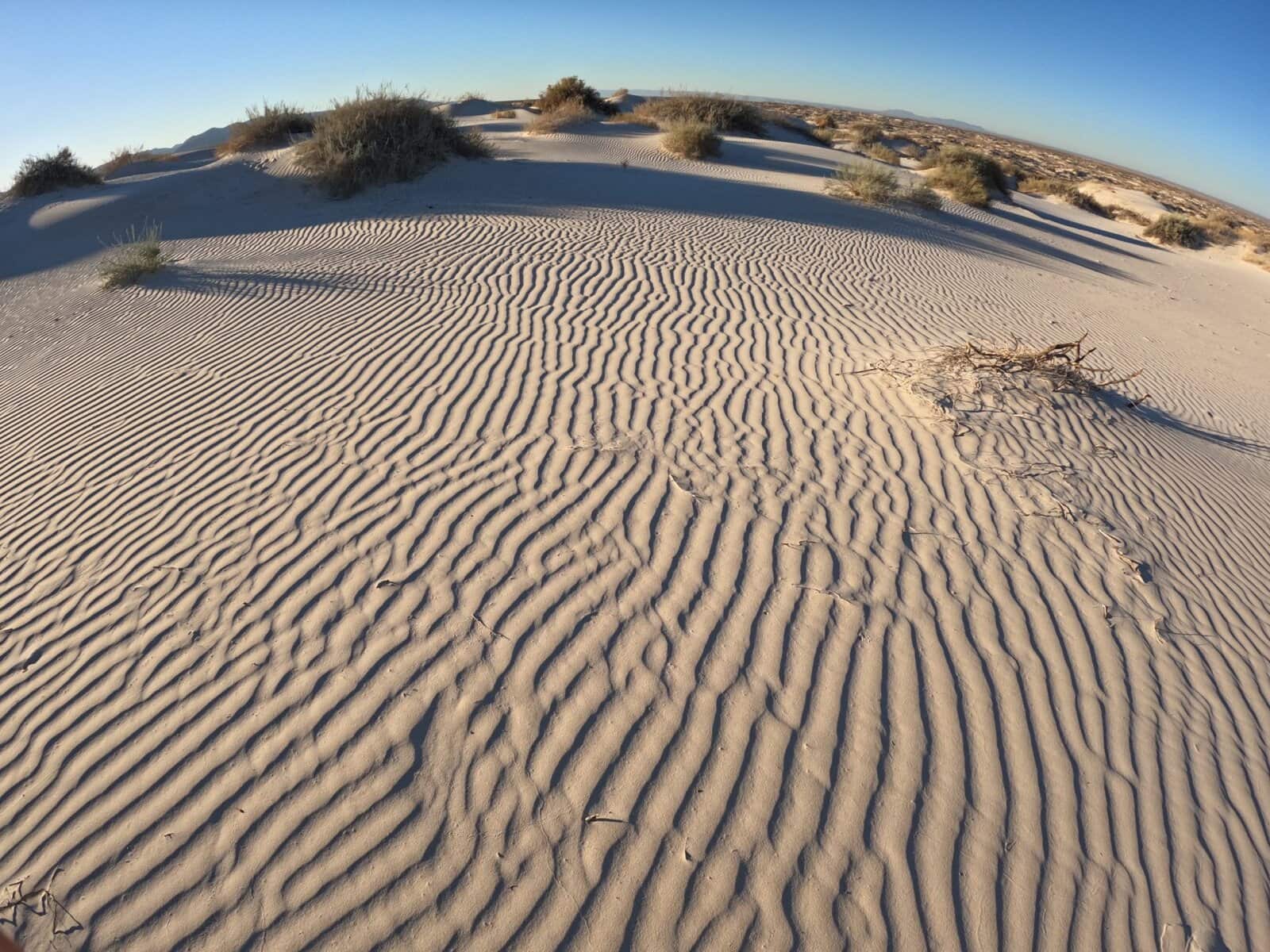
At this point my shoes were stupid-full of sand. Since the vegetation was now sparse, I took off my shoes and wandered barefoot. I may not have made that choice had I known about the scorpions.
The sand was cool and surprisingly soft underfoot. I scaled a particularly tall dune and took a moment to admire the splendor all around. The silence was spectacular. I couldn’t see my car or any other sign of civilization. Just mountains and sandy dunes as far as the eye could see.
I felt incredibly lucky to get to do the exploring that I do.
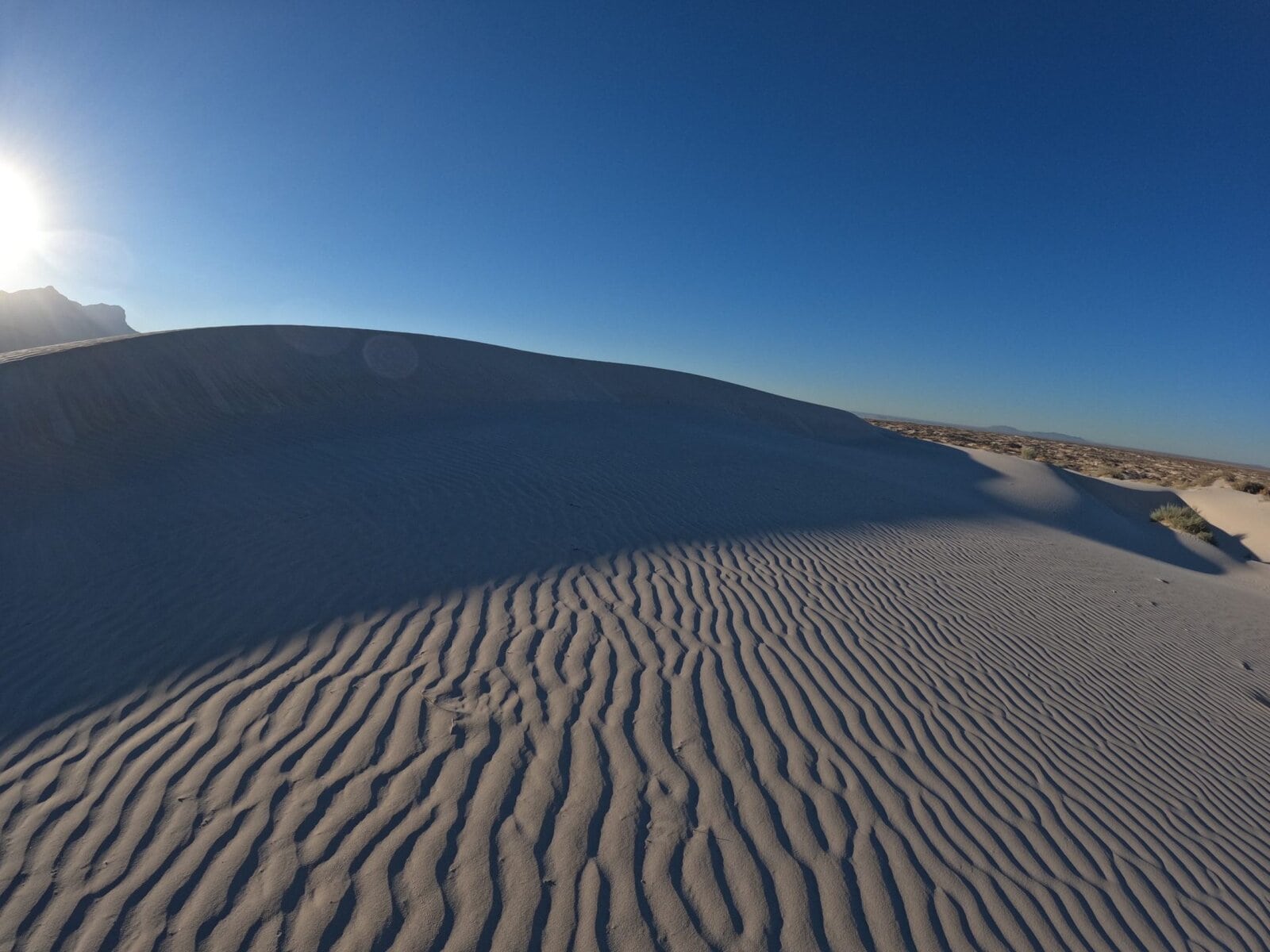
It might not look like much from the picture (blame the photographer!) but this dune is actually really big & really fucking cool!
Exiting the Dunes
Running down the dunes barefoot turned out to be a riot. As I plunged down the steep sandy banks, I slid as if running down slushy snow. Kids would fucking love this shit. I can’t wait to take my daughter.
I easily followed my footsteps back to the sign that oriented me in the correct direction of my car. There was still no one in the parking lot when I reached my car and attempted to de-sand myself. You know that was a losing battle, but I did the best I could.
I’d had the whole place to myself the entire time.
Too Long: Didn’t Read;
The Salt Basin is definitely a place to check out. For anyone interested in geology this place is a fucking jewel and for the beauty seekers and restless wanderers, such as myself, it more than satiates that wanderlust.